|
1.5.5.3 Uber HumanVersion 1.0 November 2022 (Previous Version) Some people go even further by saying that the human behaviour that is uniquely good is that which the best humans can do. These people seem to just assume that to weak is to be bad, even though this a common human trait that we share with all species. The best humans are supposedly not weak, perhaps because the strong tend to dominate and make the rules for the rest to follow. The strong themselves don't follow the arbitrary rules of society, because they don't have to, are not afraid of the law, and can get away with it. So, we are told, the best humans are above traditional morality. Friedrich Nietzsche (1844-1900) the influential German philosopher reacted against European Christian social norms. He thought both religious and naturalist justifications of morality were false, so life must be essentially meaningless. Ordinary people follow a ‘herd morality’ but it is an illusion. He proposed that a special kind of man (he was not a feminist) could rise above their genetic and environmental limitations and become a ‘great man’ who can change the world. He referred to Übermensch (literally overman) driven by a will to power. Nietzsche wrote many things and people interpret them in different ways. Some Nazis in the 1930s and 1940s, in another of their illusions, used these ideas to justify their national socialist ideas, suggesting the so called Aryans (white blond Europeans, especially Germans) were like the Nietzsche’s Übermenschen (overmen), superior to all other races. The idea that some people are special in some mystical way is an illusion.
● Some people are at the high end on some measures because they have applied themselves with learning and training to be there: eg academics, athletes, musicians, teachers, etc. Others are at the high end ‘naturally’, without effort, for instance because they are tall or insightful. Many are at the low end because the economic circumstances they were born into prevented them from flourishing. ● A small number of people will be on the high end for several characteristics, say extremely tall and excellent artists. A small number will be highly analytical, supremely empathetic, highly verbal, courageous, patient, persistent, and have persuasive voices. ● There are many great historical figures, often physically imposing but not always, often very intelligent and perceptive, often very persuasive, but nearly always driven by their convictions and a dedication to some purpose. The founders of religions are often seen that way. Political leaders such as Simón Bolívar, Winston Churchill, Mohandas Ghandi, and Nelson Mandela are seen that way by many. Such people have had an immense impact on the world. But had they been born in another time or another place, their talents may have gone unnoticed and unused, and we would never have heard of them. ● These people are special because they are statistically rare and turned out to be extraordinarily effective, not because they are somehow made of different stuff, or have a touch of the supernatural. We don't need to devise esoteric theories about Übermenschen (Nietzsche’s supermen) or other mythical humans to understand how sometimes one of these special people did things that made the world so much better. Specifically, we don't need to develop a separate set of ethical guidelines for the Übermenschen. The core values we promote apply equally well to the elites as to the commoners. ● For instance, Nietzsche said his Übermenschen would be above normal morality, at least the herd mentality, of the common people, which in his time (late 1800s CE) and place (Europe) was based on Christianity or the Enlightenment inspired rejection of Christianity. So when Nietzsche claimed his Übermenschen would be above normal morality it seems he really meant that they would not follow the discredited guidelines of the Christians or Atheists of 19th century Europe. Neither would we, but doesn’t mean we reject all value. ● In fact Nietzsche claimed that there is no objective morality. In REALigion we say that values are not things or substances (or whatever) that infuse the ether of the universe. So we can, to that extent, accept Nietzsche’s point. Our values reflect out choices and our choices reflect our values: they are not things: they depend on action; they are events, in an eventful universe. In summary: 1.5.5.3 We can't determine what is good by considering what an ideal human might be. ● The attributes of the ideal human is hotly disputed. ● Considering the attributes of successful leaders, in politics, religion, science or art doesn’t give us a good guide. A leader’s effectiveness depends on the times and the place, not just their personal attributes. ● Many of the supposedly ideal models, such as Nietzsche’s Übermenschen, or many Christian saints, are not ideal at all, not exemplary models. ● People don't come in two types: the commoners and the elites, the herd and the Übermenschen, the poor and the rich, the plebian and the party. We are all made of the same stuff, but with different degrees of many attributes.
Members can tell us (publicly) what they think of this page. How can we improve it? Enter your comments.
* * * * * * *
|
|


 English (English)
 Español (Spanish)
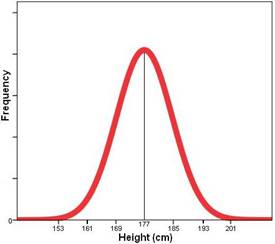 ● Many human attributes, such as height
and IQ follow a normal distribution. Most people are in the middle
range while some are very low and some are very high. For many, perhaps most,
human characteristics the distribution is not normal (ie not
symmetrical), with more people on the low side or more on the high side. Some
people are at the very high end for artistic ability, others for leadership
skills, others for mathematics or poetry or empathy or fighting skills, and all
the other dimensions on which we can measure human attributes.
● Many human attributes, such as height
and IQ follow a normal distribution. Most people are in the middle
range while some are very low and some are very high. For many, perhaps most,
human characteristics the distribution is not normal (ie not
symmetrical), with more people on the low side or more on the high side. Some
people are at the very high end for artistic ability, others for leadership
skills, others for mathematics or poetry or empathy or fighting skills, and all
the other dimensions on which we can measure human attributes. 


We acknowledge the traditional owners and custodians of Country, throughout all colonised lands, and their connections to land, waters and community. We pay respect by giving voice to truth, values and social justice, acknowledging our shared history, and valuing the cultures of first nations peoples.
Copyright © 2008 - 2026 Trevor J Rogers, care of the address shown on this page. All rights reserved. Apart from any fair dealing for the purpose of private study, research, criticism or review, as permitted under the Copyright Act, no part may be reproduced by any process without written permission from the copyright owner. Any approved reproduction is permitted only with full attribution of the source, referring to this site and this copyright notice. The moral right of the author is asserted.
Top